Creative and Media Reunited. This Time, Attention Is the Currency.
John Osborn
President US
For most of my time in the industry, creative and media lived separately. On separate floors or in separate buildings. Sometimes separate cities. They shared clients but rarely shared thinking. The creative team made the ad. The media team decided where and how it ran. And somewhere in that gap, a lot of value got lost. Ads that weren't seen. Measurement practices that hadn't caught up yet.
That model made sense in a different era. Television dominated. Inventory was scarce. You bought the right slot, trusted the environment, and the impression was good enough. It isn't anymore. Average focus on a single screen has dropped from two and a half minutes to under 47 seconds in two decades. The environment changed. Our measurement didn't.
We've built an industry where ads technically run, technically deliver impressions, and technically hit viewability targets. But fewer and fewer are actually watched. I sometimes refer to this as the "unbeautification" of advertising. Even great creative work, when it lands where nobody's paying attention, becomes invisible. This isn't a blame thing. It's structural. And it's one creative and media need to fix together.
The impression was always a proxy
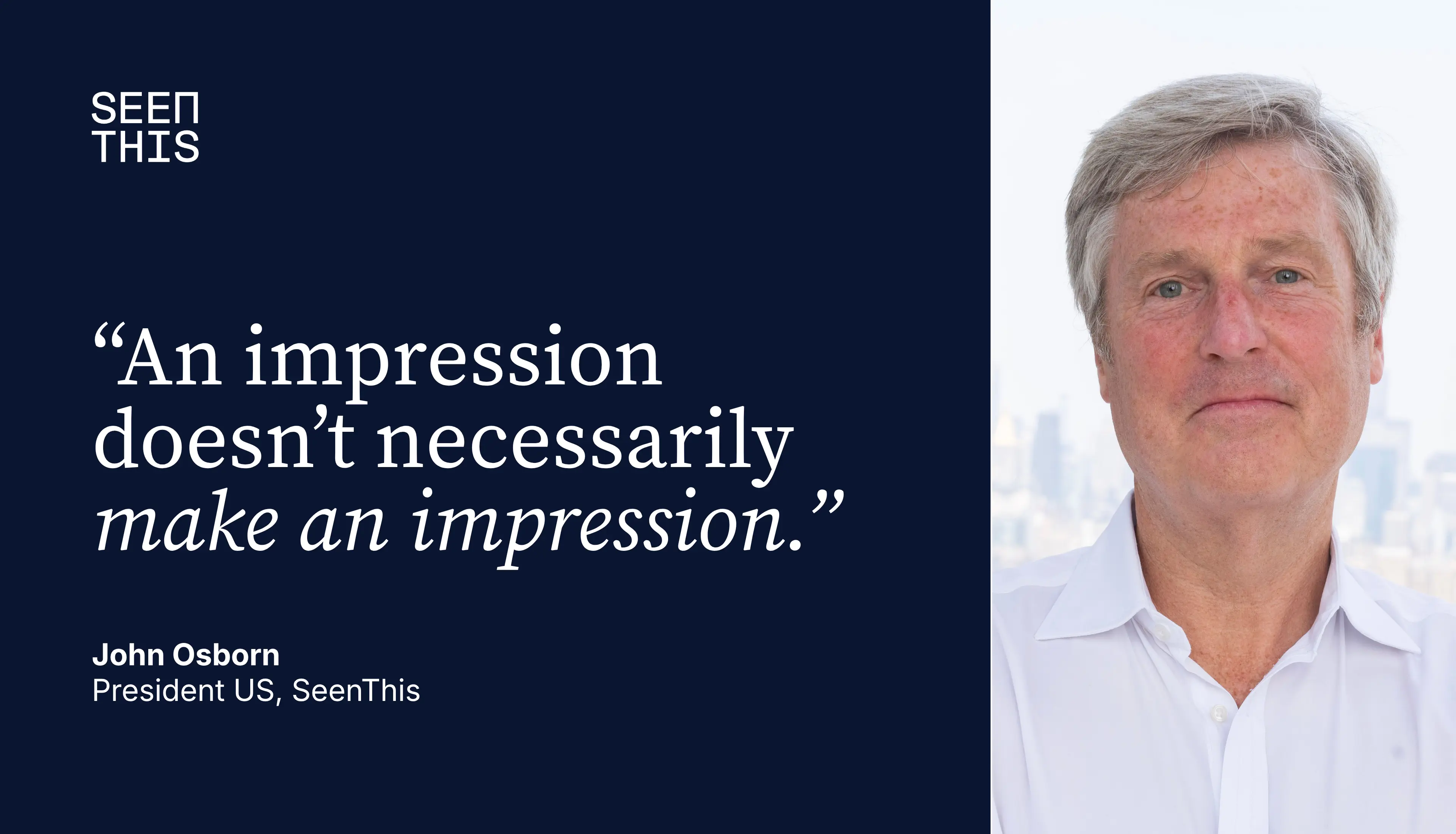
Viewability moved us forward, but a viewable ad is not a seen ad. An impression doesn't necessarily make an impression. You can hit every benchmark and still reach nobody. And if nobody watched, there was no incremental impact. No brand lift. No consideration shift. The ad existed, technically. But it didn't work.
In the last couple of years, I've personally seen this play out in the real world. The numbers say one thing, reality says another. Campaigns that checked every box on paper but left no mark on the people they were supposed to reach.
What comes next is simpler and more honest: attention as the actual unit of value. Not impressions served. Not viewability scores. How long someone actually watched, measured in attentive seconds. That's the currency that connects media spend to business outcomes. You can't move someone who never noticed you.
Where the attention actually lives
American consumers spend more than 60% of their time online on the open internet. But roughly 70% of digital ad spend flows to walled gardens.
That gap has been slow to close, partly because the walled gardens are also the ones providing the measurement.
The data is starting to make this hard to ignore. According to Lumen Research, social video generates an average of 1.5 attentive seconds per impression. Legacy out-stream gets 2.1. Streamed video on the open web delivers 2.5. The channels that get the most investment are generating the least actual attention.
The budgets and the attention are in different places. And now we can actually see it, because the measurement has caught up. At SeenThis, our work with Lumen Research has shown that adaptive streaming generates 1.7 times more attentive seconds than conventional delivery. The attention is there. It's measurable. It's on the open web.
The best campaigns I've been part of never treated creative and media as separate decisions. The environment shapes how long someone looks. The creative determines whether they stay. The industry doesn't need another framework. It needs a simpler question: did anyone watch? When creative and media teams start optimizing around that together, the waste shrinks, the work gets better, and the results follow.
That's the reunion worth having.
John Osborn is President US at SeenThis. He previously served as CEO of OMD USA and CEO of BBDO New York.
eMarketer — Triopoly's share of ad spend (July 29, 2025)
—


